
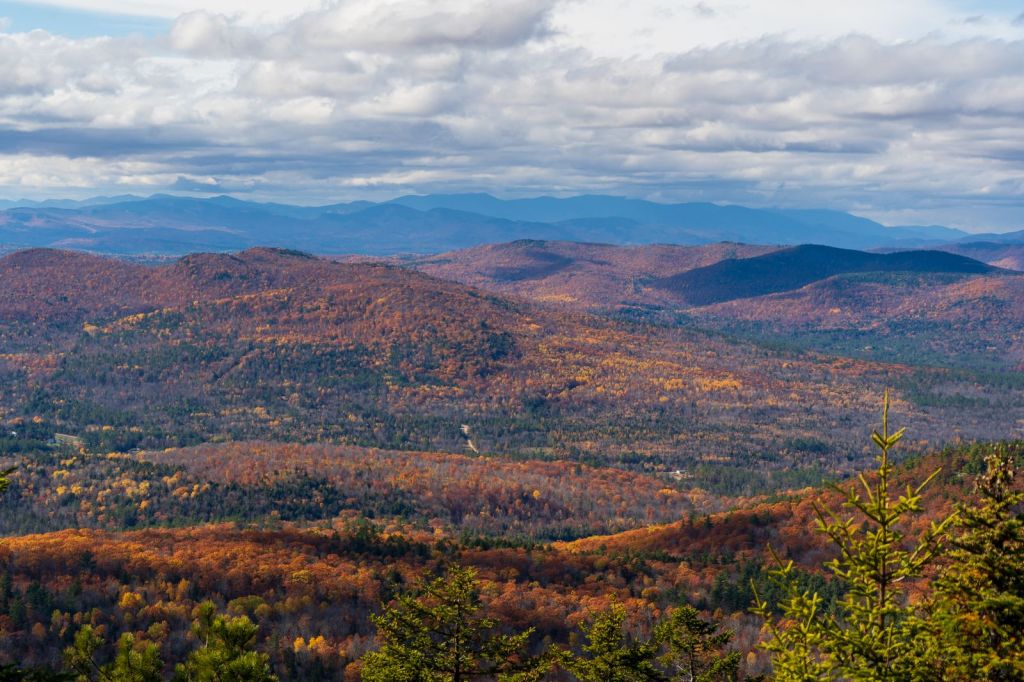
A New England fall foliage guide: four routes across Massachusetts, New Hampshire, Connecticut, and Vermont — how to nail the timing, and where to point the car.
The best moment of a New England foliage trip — a maple ridgeline at peak, backlit at four in the afternoon — looks exactly the same from a $700 resort balcony as from a gravel pull-off on Route 2. That’s the humbling thing about leaf season: the headline act is free and identical for everyone, which makes overspending easy and completely beside the point.
And the rest of the trip is built from small, inexpensive, perfect things: cider doughnuts and just-picked apples eaten in the crisp air with a ridgeline going gold in front of you; the classic diner or mountain coffee shop you’ll stumble into on every one of these routes, because New England fall air just demands it.
The idea behind it: Five-Star Math
This is the second guide in a series built on one idea we call Five-Star Math: a way to travel well without overpaying for it. A trip is hundreds of spending decisions, but only a handful create the memories — five or so. Spend deliberately on those; keep everything else simple. What makes a trip feel rich isn’t the budget, it’s the attention behind a few choices. (We broke all five down with real numbers in the first guide, on Cape Town.)
The five, in plain terms:
- The room — chosen for what it actually does for you (light, location, the walk to dinner), not its brand name.
- One meal worth booking ahead.
- One experience you could only have right there.
- The inexpensive meals that somehow outlast the fancy ones.
- One thing you bring home with a story attached.
Foliage is where the framework nearly breaks, in a useful way. Four of the five levers barely move here — where you sleep, what you eat, what you bring home are nice, but they’re not why the trip is good. The trip is good because of what’s out the windshield, and that’s free. So leaf season collapses Five-Star Math down to two decisions that actually change your trip: when you go, and which road you drive. Get those right and a tank of gas buys you the best view of the year.
Decision one: when
Foliage isn’t a date — it’s a wave that rolls north-to-south and high-to-low, holding peak in any one spot for about a week. The classic mistake is picking the dates first and the place second. Do it backwards: decide when you can go, then choose the route that’s peaking then.
| If you can travel… | Go here (it’s peaking) | Skip for now |
|---|---|---|
| Late September | Northern/high Vermont & the upper White Mountains (NH) | Connecticut (still green) |
| First week of October | The White Mountains (NH) & the Berkshires (MA) | — |
| Second week of October | Vermont’s Green Mountains & Stowe, the Mohawk Trail (MA) | — |
| Mid-to-late October | The Litchfield Hills (CT) | The northern mountains (past peak) |
2026 note: the White Mountains are forecast for full color around October 5–10 — a “late but great” year. Confirm against a live tracker the week before you leave.
The free move inside this: go midweek and a few days before the obvious peak weekend. You’ll trade five percent of the color for half the traffic and a fraction of the rate — on the Kancamagus over Columbus Day weekend, the difference between an open scenic drive and three hours of bumper-to-bumper traffic. To time it, use the national SmokyMountains.com map for planning months out, then each state’s weekly in-season foliage report for the final call.
Decision two: which road
You cannot do all of New England’s foliage in one trip — the Berkshires, the White Mountains, Vermont’s spine, and the Litchfield Hills are hours apart. Pick one route per long weekend — they reward the slow-drive crowd and the get-out-and-hike crowd in equal measure. Here are four: three we’ve driven, and one we’re driving next.
Route One · Massachusetts
The Mohawk Trail
Peaks: late September to mid-October.
The Mohawk Trail is ~37 miles of Route 2 from Greenfield to North Adams through the northern Berkshires — sugar-maple reds, honey-locust yellows, and one hold-your-breath hairpin above the Hoosic Valley. It’s the least crowded of the famous drives and the most underrated.
Where to base it. We’d steer this by preference rather than hand you one hotel. If the drive is the point, an Airbnb around Shelburne keeps you in the middle of it. For a town to come home to, two anchors sit five miles apart: Williamstown is the prettier, more walkable one — the Clark Art Institute, and the Williams Inn if you want one great hotel — but it can feel sleepy. North Adams has the buzz now, and the most original stay on the whole route: TOURISTS, a one-of-a-kind reinvention of the roadside motel — a 1960s motor lodge reborn in Sea Ranch–style blond wood across 80 wooded acres, with a 220-foot suspension bridge over the Hoosic River to an art-dotted trail (and a Wilco pedigree — the band’s bassist is a founding partner). They’re close enough to sleep in one and spend evenings in the other.
Don’t miss MASS MoCA. North Adams is built around it now, and for good reason: MASS MoCA is the largest contemporary-art museum in the country, sprawling through twenty-odd former mill buildings — football-field-sized galleries, room-filling installations you walk through, and the largest collection of Sol LeWitt wall drawings anywhere. It’s spectacular and genuinely unlike anything else, and it’s the perfect move on a gray afternoon when the light won’t cooperate.
Golfers, this one’s personal. Taconic Golf Club in Williamstown is a stunner — one of us played college tournaments here, and it was the favorite, especially in the fall. There’s no better way to take in the color than walking eighteen holes through it.
For food, we lean to the unfussy gems — The Perch, The Blue Rock, the Wicked Good Cafe, and a morning coffee at Shelburne Falls Coffee Roasters — though the Berkshires do gourmet too on the night you want it.
Get outside. Drive up Mount Greylock (the state’s highest point, and a free view), then pick your pace among the parks: Natural Bridge State Park and Tannery Falls for an easy wander, Mohawk Trail State Forest and the Hoosac Range Reserve if you’d rather earn the view on foot.
And do the farm stands — the part that’s truly special in the fall, and the part we have core childhood memories of: apple picking, then home on a caramel-apple-and-cider-doughnut sugar high. Hager’s Farm Market in Shelburne (seventh-generation, with maple creemees and pick-your-own) or Apex Orchards for the view with your apples.
Honestly, our best day here had no reservation in it: a coffee from somewhere local, a slow drive out to the falls, an afternoon just being in it — then an evening in a small town with a good book. That’s the whole thing. The leaves are free, and they’re the point.
Route Two · New Hampshire
The Kancamagus & Franconia Notch
Peaks: first two weeks of October; full color ~Oct 5–10 in 2026.
If the Mohawk Trail is the quiet one, the Kancamagus (“the Kanc”) is the showpiece: 34.5 miles between Lincoln and Conway with no gas, no billboards, no development — just overlooks, the Swift River, and waterfalls. Add Franconia Notch (Flume Gorge, the Cannon Mountain tram) at the west end and Mount Washington to the north, and it’s the most dramatic foliage drive in the country. One non-negotiable tip: there’s no gas or food on the whole Kanc — fill up in Lincoln or Conway, then don’t rush it.
Make a trip song. The most Borrowed Luxury tip in this guide, and it’s free. One of us grew up doing this at summer camp in the White Mountains: every hiking group wrote a trip song on the drive back — a funny recap of the day set to whatever was on the radio — and performed it for the whole camp. Do the same on your foliage drive. It’s the thing you’ll remember in ten years, long after you’ve forgotten what the room cost. The best souvenirs are free, and often a little embarrassing.
Where to point the GPS. You can’t go wrong on the Kanc — string together Sabbaday Falls, Champney Falls, the Overlooks, and the Historic Albany Covered Bridge. To climb something, pick a peak to match your legs: Rattlesnake Mountain near Squam Lake is a short hike to a huge panorama; Mount Washington is the highest in the Northeast (drive the Auto Road or ride the Cog). For a special night, book the Café Lafayette Dinner Train in North Woodstock — a five-course meal in restored 1950s rail cars. With kids, Story Land is genuinely great. For cider doughnuts: Windy Ridge Orchards.
One to book now. If you do a single paid thing on this drive, make it the Cannon Mountain Aerial Tramway in Franconia Notch — North America’s first, and in its final season this year (the historic tram retires after October 26, 2026). Ten minutes up, a four-state view at the top, and the whole notch going gold beneath you.
Eat & sleep. The food runs hearty — this is ski country. The Common Man in Lincoln is a historic classic; May Kelly’s in North Conway is a proper Irish pub; breweries (Sea Dog among them) are everywhere. To stay, match the budget: small and characterful (Launchpoint Lodge, the Aurora Inn), a grand-resort splurge (the Omni Mount Washington at Bretton Woods — yes, that Bretton Woods, where the 1944 conference rebuilt the post-war global economy — or the Mountain View Grand), or the reliable points properties and Airbnbs near the highway.
Route Three · Connecticut
The Litchfield Hills — the real Stars Hollow
Peaks: mid-to-late October — the latest of the four, and the natural pick from NYC (~two hours up).
The Litchfield Hills, in Connecticut’s northwest corner, are the state’s foliage heart: colonial hilltop towns, white churches, covered bridges. The spine is Route 7 through Kent, past the West Cornwall covered bridge — the most-photographed in the state. And yes, this is the real Stars Hollow: Gilmore Girls creator Amy Sherman-Palladino dreamed up the show while staying at the Mayflower Inn in Washington Depot, right here. The town green, the diner, the whole fall-in-a-small-town feeling — this is where it came from.
Where to point the GPS. Base in the picturesque trio — Litchfield, New Milford, or Kent — with White Memorial Conservation Center and Mt. Tom State Park for a leaves-and-a-walk afternoon, and a Route 8 drive up to Torrington as an easy add. Don’t skip the towns just south: Woodbury, Roxbury, and Washington Depot.
Eat. This is the corner we know best. Arethusa al Tavolo is the splurge and worth it; Community Table and Market Place Kitchen & Bar round it out. But the one with a story is Dottie’s Diner in Woodbury — we went to high school not far from here, and a box of those was the treat. For dessert, Rich Farm Ice Cream in Oxford is some of the best around (it made Yelp’s Top 100 in the country). And for cider doughnuts and pick-your-own: March Farm in Bethlehem, Averill Farm in Washington Depot, and Waldingfield Farm in Washington — the owners are fantastic, and deeply committed to their community.
Stay. The Mayflower Inn & Spa is the once-in-a-while splurge (and the Gilmore Girls pilgrimage). For something gentler on the budget, the Hills are full of country inns and Airbnbs — we’ll name specific picks once we’ve stayed in them ourselves. If you love antiques, the whole corner is a treasure hunt.
Route Four · Vermont (next up)
Route 100 & Smugglers’ Notch
Next on our list. Peaks: ~second week of October.
If one road owns the foliage imagination, it’s Route 100 — 146 miles down Vermont’s spine through the Green Mountains. The classic base is Stowe, where Smugglers’ Notch squeezes through the mountains in full color. We haven’t driven it in leaf season yet, so we won’t pretend we have — we’re headed to Vermont this November (and the honest caveat: by November the leaves are down; for foliage you want early-to-mid October). We’ll add a full Vermont route once we’ve been.
A note on Maine. In fall, Maine is really two long-haul trips — the inland mountains peak early October, the coast and Acadia mid-to-late — and neither is a quick add-on. It earns its own trip, in summer or ski season. A dedicated Maine guide will come when it’s the right season.
What actually costs money (and what doesn’t)
| Worth paying for | Free — and the real reason you came |
|---|---|
| One dinner you book ahead | The drive itself — every mile of all four routes |
| A room just off the marquee town (midweek rate) | Every overlook, every pull-off, the light at 4 p.m. |
| One signature experience (MASS MoCA, the Cog Railway, the dinner train) | Mount Greylock, a covered bridge, a waterfall walk |
| Apple picking and a bag of cider doughnuts | The crisp air and the views while you eat them |
You can run this trip on a tank of gas, a farm stand, and one dinner — or spend four figures on a peak-weekend resort and watch the same leaves through the same traffic. The leaves don’t know the difference.
Quick reference
Peak timing: New Hampshire’s White Mountains, first two weeks of October (2026 ~Oct 5–10) · Vermont’s Route 100, ~second week of October · Massachusetts Berkshires, late September to mid-October · Connecticut’s Litchfield Hills, mid-to-late October (latest, and closest to NYC).
The drives: Mohawk Trail (MA, Route 2, ~37 mi) · Kancamagus Highway (NH, Route 112, 34.5 mi — no gas or food) · Litchfield Hills (CT, Route 7) · Route 100 (VT, 146 mi).
Getting around: A car is the trip. Book lodging ahead — peak weekends sell out months out. Beat the crowds for free: midweek, start early, lead with the higher/northern stops, and avoid holiday weekends on the famous roads.
FAQ
When is peak fall foliage in New England?
It rolls north-to-south and high-to-low. Northern Vermont and the New Hampshire White Mountains peak in the first two weeks of October; the Massachusetts Berkshires run late September to mid-October; Connecticut’s Litchfield Hills peak latest, mid-to-late October. Check a live state tracker the week before you travel.
What’s the best fall foliage road trip in New England?
There isn’t one — there are several, too far apart to combine. Pick by your dates: early October favors New Hampshire’s Kancamagus or Vermont’s Route 100; mid-October favors Massachusetts’ Mohawk Trail; mid-to-late October favors Connecticut’s Litchfield Hills, the easiest from New York City.
When is peak foliage in New Hampshire?
The White Mountains typically peak in the first two weeks of October, higher elevations first. For 2026, full color is forecast around October 5–10.
When is peak foliage in Connecticut?
The northwest corner — the Litchfield Hills — turns mid-to-late October. Because it peaks later than the northern mountains, it’s a good “I missed peak up north” backup, and the closest New England foliage to NYC.
Where can I see fall foliage near New York City?
Connecticut’s Litchfield Hills, about two hours north, peaking mid-to-late October — colonial towns, covered bridges, the Route 7 drive. It’s also the real-world inspiration for Gilmore Girls’ Stars Hollow.
Is fall foliage season expensive in New England?
It’s peak season, so lodging runs high and the best inns sell out. But the main event — the drives and the color — is free. You save most by going midweek or pre-peak and staying just outside the marquee towns, not by skimping on the one good dinner.
What is the Five-Star Math approach to travel?
A framework for getting the most from a travel budget: make five deliberate choices (the right room, one serious meal, one only-there experience, the inexpensive meals that outlast the rest, and one thing to bring home with a story) and keep everything else simple. On a foliage trip the biggest lever is timing — because the best part is free, and the same for everyone.
A note on prices: attraction pricing (Flume Gorge, the Cannon Mountain Tramway, the Mount Washington Cog Railway and Auto Road) moves year to year — check each operator’s site, and a live state foliage tracker, before you travel.

